THE HANDS-IN-PHOTOS GUIDE
What to Do With Your Hands in Photos: 6 Ideas
Give your hands one small job: a pocket, a coffee cup, a hair tuck, a bag strap, a sleeve cuff or a railing. Plus the stiff-to-relaxed fix and sitting poses.
Try the idea on your own photo with Stunna.


Free to download. Pro options available.
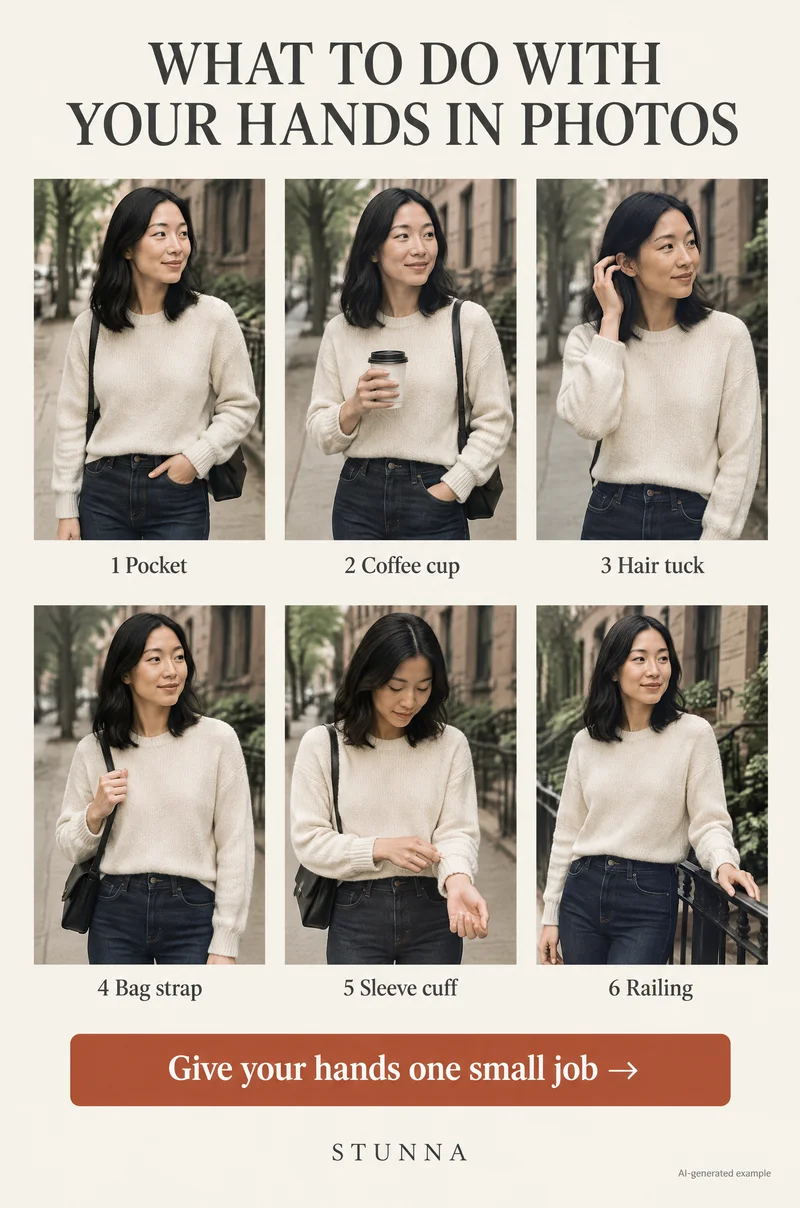
Most people know how to smile for a photo. Hands are harder: the moment a camera comes out, they hang, clench or press flat against a thigh. The fix is simple and works for almost everyone: give your hands one small job. Below are six ideas, the quickest stiff-to-relaxed fix, sitting options and a way to direct a friend. The illustrations are AI-generated examples, not actual Stunna results.
Why hands look awkward in photos
Hands show tension before faces do. When you are unsure what to do, your arms tend to drop straight down, your palms press flat against your legs or your fingers curl into a loose fist. In person nobody notices. In a still photo those shapes read as stiff, because they look like someone waiting for the shutter instead of living a moment.
Relaxed hands have two things in common. They are doing something, even something tiny, and the fingers are soft and slightly bent rather than straight, spread or gripping. You do not need to learn hand modeling. You need one job for the hands and a breath out before the frame.
The 6 hand ideas
Save these six and run through them on your next photo walk. Each one gives your hands a reason to be where they are, which is what makes a pose look natural instead of arranged.
- Pocket: slide one hand into a coat, jacket or jeans pocket, or hook just the thumb in. Let the elbow relax outward a little so there is space between your arm and body. One hand in, one hand free usually looks easier than both hands buried.
- Coffee cup: hold a takeaway cup at chest or waist height. Wrap your fingers loosely around it rather than gripping, and let the other hand support the base or rest at your side. A cup also explains why you are standing there.
- Hair tuck: tuck a strand behind your ear, or run your fingers lightly through your hair, while the photographer takes a few frames. The in-between moments, when the hand is moving, usually look better than a held pose.
- Bag strap: hold the strap of a shoulder bag or tote near your collarbone or at hip height. It is one of the most natural hand positions there is, because it is what you do anyway when walking.
- Sleeve cuff: adjust a sleeve, roll a cuff or pull a sweater sleeve over your fingers. Small fiddling actions give the hands something to do and add texture to the photo without a prop.
- Railing: rest one forearm or hand on a railing, wall, bench back or bridge and shift your weight toward it. Leaning gives the arm a purpose and breaks the straight vertical line of a standing body.
The easiest fix: hold something
If you only remember one idea, make it this one. Holding something real gives your hands a reason to be in the frame and turns a pose into a moment. A coffee, a bakery bag, a book, a bunch of flowers, your jacket over one arm or a pair of sunglasses all work. The object does not need to be interesting; it needs to be believable for where you are.
Keep it to one or two things. A coffee in one hand and a paper bag in the other reads as a morning errand; a coffee, a phone, a bag and a book reads as juggling. Hold objects a little away from your body so they do not press into your clothes, and keep your grip light. A tight grip shows in the knuckles.
Holding something also helps when you are walking. Our walking photo poses work especially well with a cup or bag in hand, because the arm swings naturally instead of hanging.
Stiff vs relaxed: the quick fix
If a photo looks stiff and you cannot tell why, look at the arms first. Arms hanging straight down with flat hands against the thighs, shoulders square to the camera, is the classic awkward frame. Three small changes fix most of it in a few seconds.
- Hook a thumb: put one thumb in a front pocket or belt loop and let the fingers rest on the outside. It is subtle, works for any outfit with pockets and instantly gives the arm an angle.
- Hold your jacket: take the edge of an open jacket, overshirt or cardigan in one hand, or hold the lapel near your chest. It frames the body and gives the second hand a job.
- Shift your weight: stand on your back leg and soften the front knee, then turn your body slightly away from the camera and bring your face back toward it. The arms fall into a more relaxed line on their own.
Hands in sitting photos
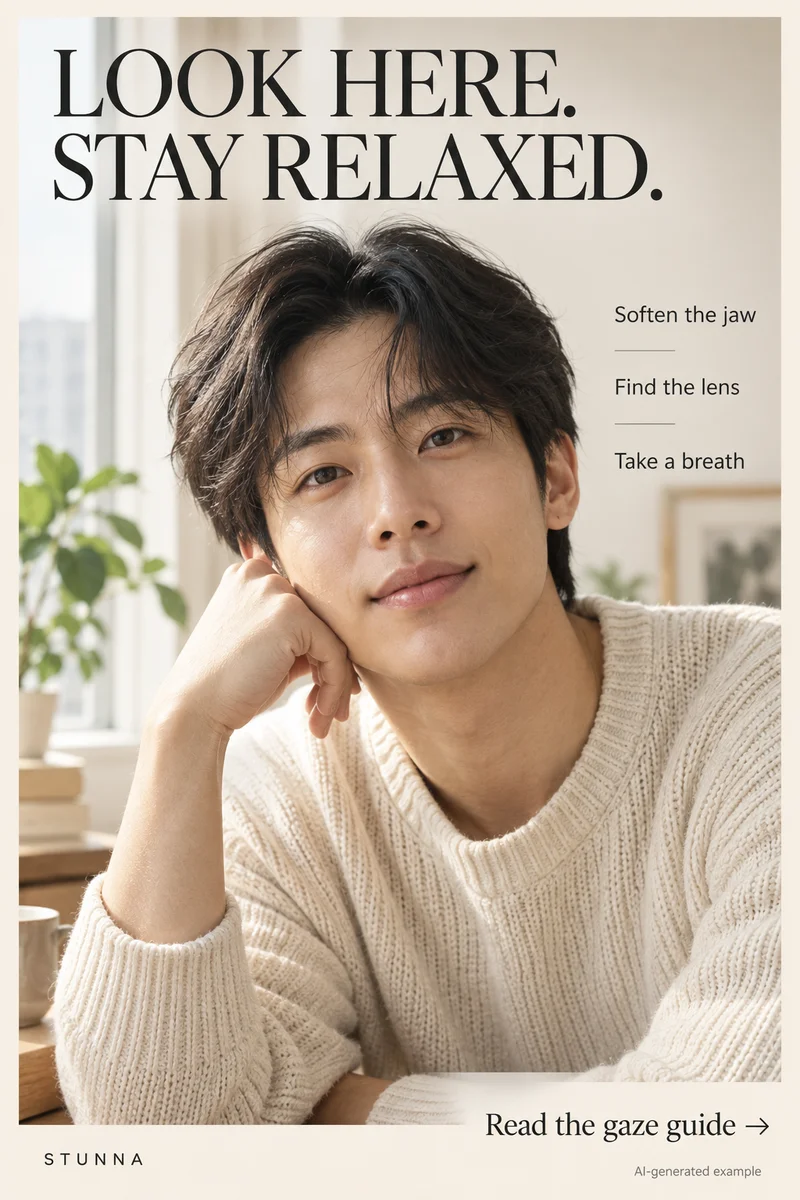
Sitting makes hands easier, because there are more surfaces to use. At a table, wrap both hands around a cup, rest one forearm on the table edge or hold a menu or book. Keep elbows off the very front of the table so your hands do not end up closest to the lens, where they look bigger than they are.
On a bench, step or wall, rest one hand on your knee and let the other hold the edge of the seat beside you, or rest your forearms on your knees and lean forward slightly. A light hand near the chin can look thoughtful, but keep it soft: no pressing into the cheek, and no single raised finger near the face, which can read as an unintended gesture once the photo is small.
For more seated setups with light and framing tips, see our café sitting poses.
How to direct a friend
Most people freeze when told to relax. Directions work better when they are actions rather than descriptions. Instead of saying relax your hands, say put your thumb in your pocket, hold your coffee with both hands or fix your sleeve. Give one instruction at a time and shoot while they do it.
Call out hands specifically when you see them stiffen: shake them out, then try again. Take a short burst or several quick frames during each action, because the frame where the fingers are mid-movement is often the softest. Show your friend two or three frames on the phone after the first round; seeing what works helps more than any instruction.
If you are photographing two people, give each person a different hand job so they do not mirror each other. Our couple photo poses guide has more simple directions for pairs.
Common hand mistakes
These are the most frequent reasons hands spoil an otherwise good photo, with a quick fix for each.
- Flat palms on the thighs: turn the hand slightly sideways or move it to a pocket or strap.
- A clenched fist or a claw: breathe out and let the fingers curl softly, as they do when you are not thinking about them.
- Hiding both hands completely: one visible hand usually looks more natural than none, especially in close portraits.
- Hands pushed toward the lens: keep them roughly level with your body so the camera does not enlarge them.
- Cropping at the wrist or fingers: crop above or below joints, or include the whole hand.
- Too many props: one or two believable objects are enough.
Phone tips for better hand shots
Use the main camera rather than the ultra-wide for portraits. The ultra-wide stretches anything near the edge of the frame, and hands are often near the edge. Step back a little and crop later instead of moving the phone closer.
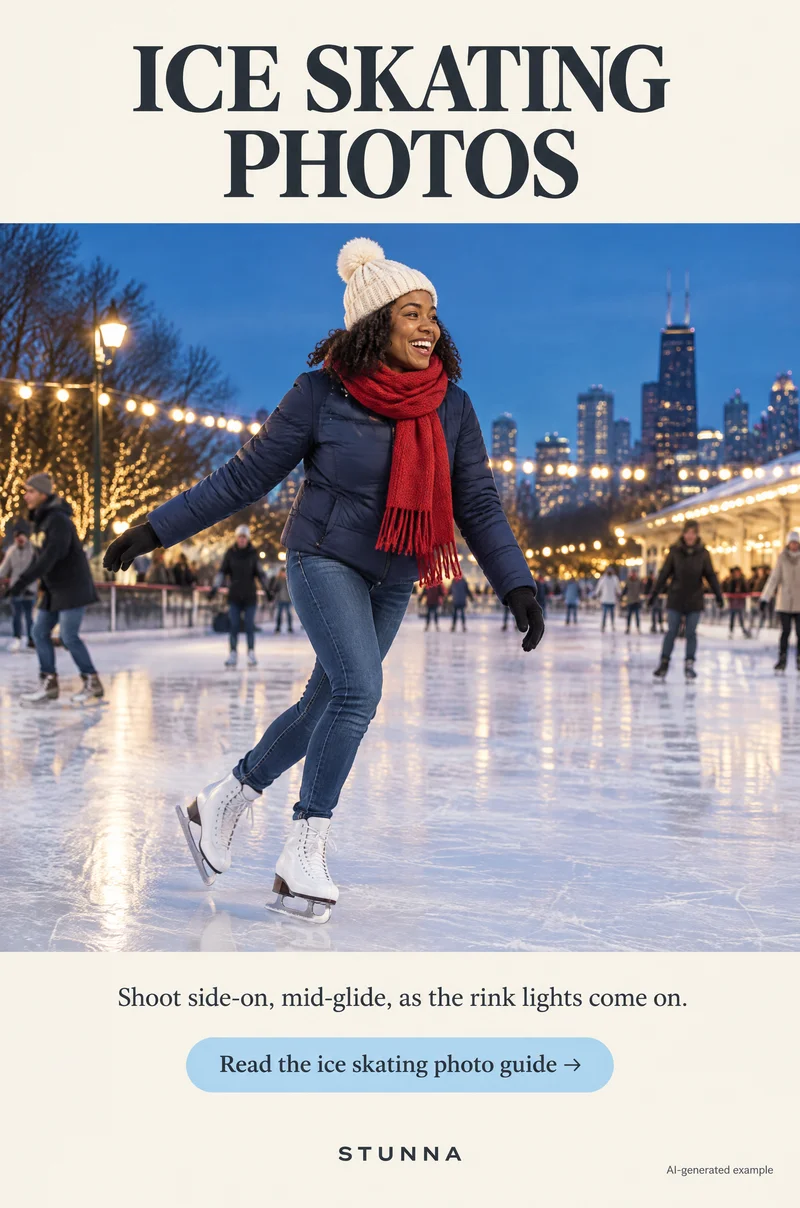
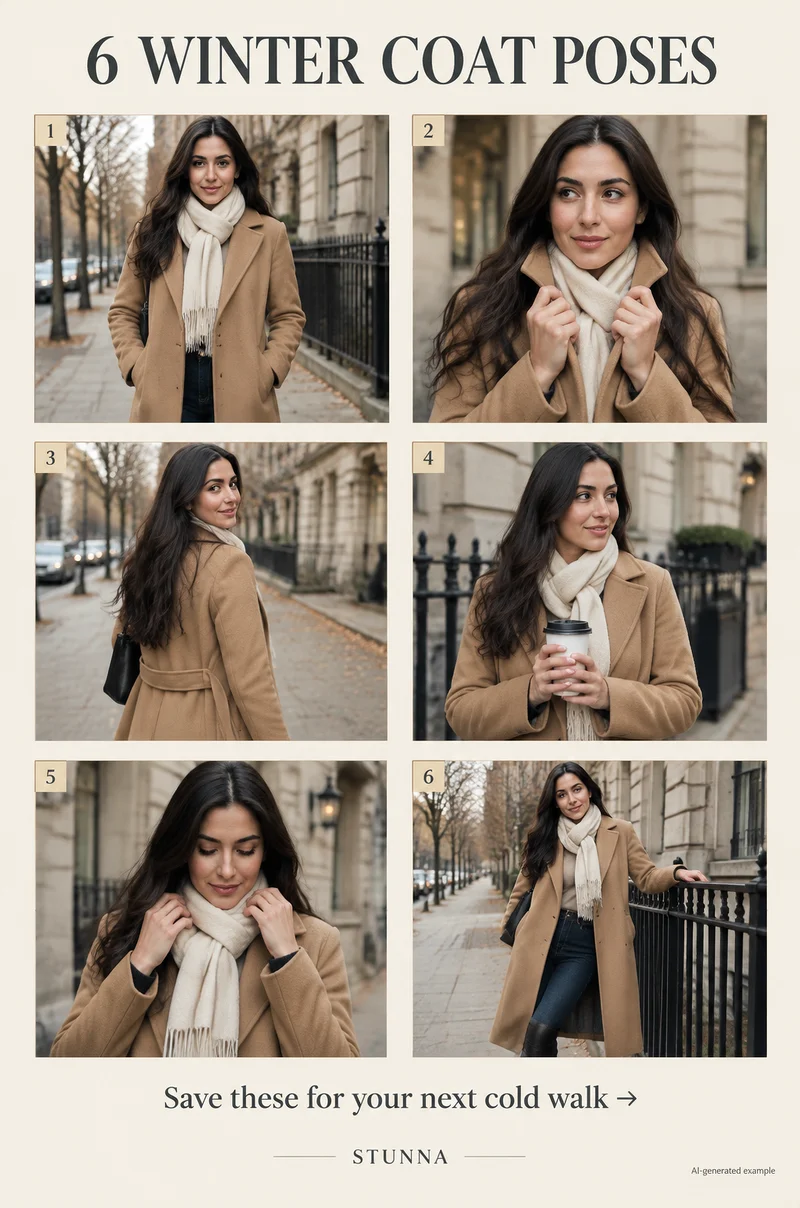
Burst mode and Live Photos make hand poses much easier, because you can choose the frame where the fingers look relaxed. Camera controls vary by device, so check what yours offers; tapping the shutter several times works on any phone. For more full poses built on the same idea, browse our easy photo poses, the larger list of poses for pictures and these winter coat poses. Holding hands is its own skill on the ice; our ice skating photo guide shows how to make it look easy.
A few useful answers
What should I do with my hands in photos?+
Give them one small job: a hand in a pocket, holding a coffee cup, tucking your hair, holding a bag strap, adjusting a sleeve cuff or resting on a railing. Keep the fingers soft and slightly bent.
How do I stop my hands looking awkward in pictures?+
Hook a thumb in a pocket, hold the edge of your jacket and shift your weight to one leg. If you still feel stiff, hold something real, such as a coffee or a bag.
What do I do with my hands in sitting photos?+
Wrap both hands around a cup, rest a forearm on the table or a hand on your knee, or hold a book or the edge of the seat. Keep hands roughly level with your body so they do not look oversized.
Should I hide my hands in photos?+
Usually not. One relaxed, visible hand tends to look more natural than hands tucked completely out of sight, especially in close portraits.
How can I help a friend with awkward hands?+
Give an action instead of saying relax: put your thumb in your pocket or fix your sleeve. Shoot several frames while they do it and show them the best one.