THE WINTER COAT POSE GUIDE
6 Winter Coat Photo Poses That Look Natural
Hands in pockets, collar up, looking back mid-step, a warm drink, adjusting your scarf and leaning on a railing. Six coat poses that give your hands a job.
Try the idea on your own photo with Stunna.


Free to download. Pro options available.
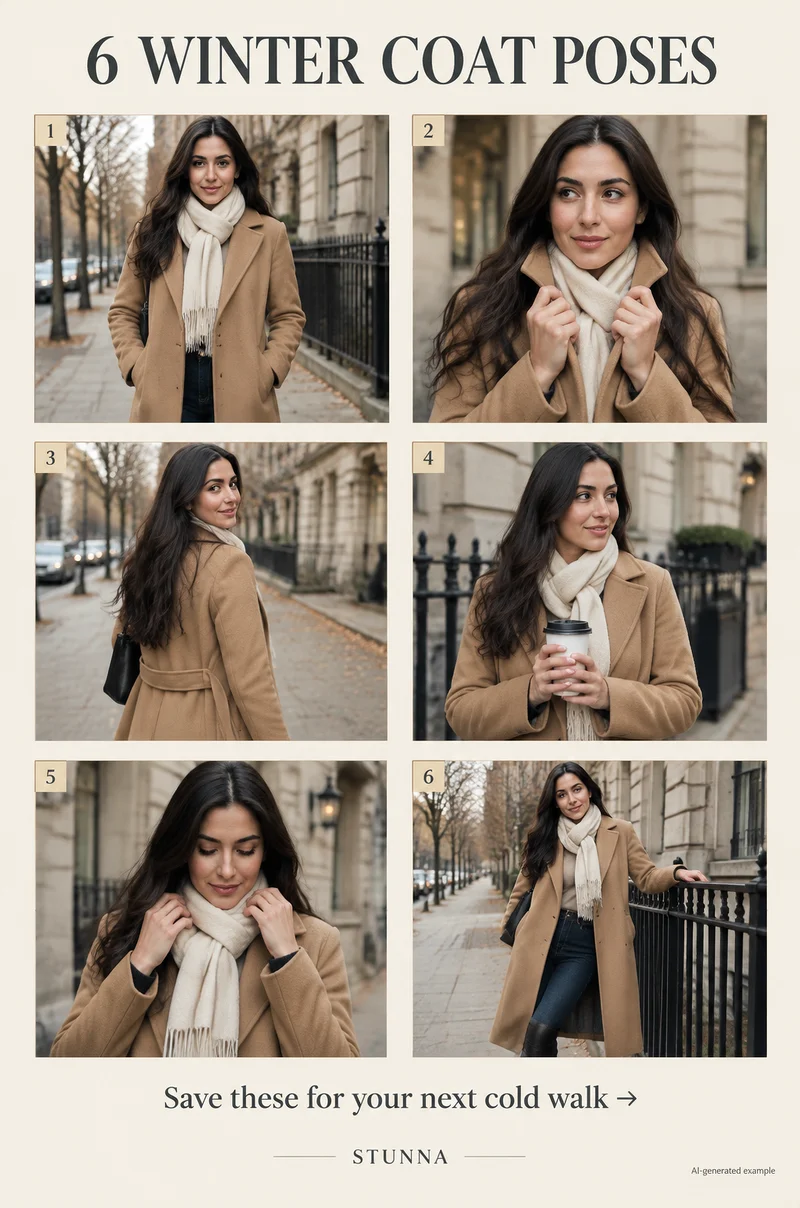
A good coat already does half the work in a winter photo. What usually goes wrong is standing still with arms hanging straight down. These six poses give your hands something to do and let the coat move. The illustrations are AI-generated examples, not actual Stunna results.
Why coat photos look stiff
A heavy coat hides the shape of your body, so small posture cues matter more. Arms straight down make the coat hang like a box. Standing square to the camera with weight on both feet adds to the stiffness, and cold makes people tense their shoulders.
The fix is to give your hands a job and add a little movement. A hand in a pocket, a turned shoulder or a step creates angles in the fabric, and those angles are what make an outfit photo look relaxed.
The 6 winter coat poses
Save these six in order and run through them on your next cold walk. Each one takes a few seconds.
- Hands in pockets: slide both hands, or just one, into the coat pockets and let your elbows relax outward slightly. It opens space between your arms and body so the coat's shape shows.
- Collar up: lift or hold the collar with one hand near your jaw. It frames the face and explains the cold without anyone needing to shiver for the camera.
- Looking back mid-step: walk away from the camera, then glance back over your shoulder as you take a step. The coat swings and the turn gives a natural, unposed angle.
- Holding a warm drink: hold a coffee or tea at chest height with both hands. It occupies your hands, adds a color accent and makes the photo feel like a moment rather than a pose.
- Adjusting your scarf: tug, wrap or loosen your scarf while the photographer shoots a few frames. The in-between frames usually look the most natural.
- Leaning on a railing: rest one forearm or both hands on a railing, bridge or wall and shift your weight toward it. Leaning breaks the straight vertical line of a long coat.
Move, then shoot
Stiff coat photos usually come from standing still and waiting for the shutter. Walk, turn or adjust your collar instead, and have the photographer take the shot mid-movement so the coat hem and sleeves move naturally.
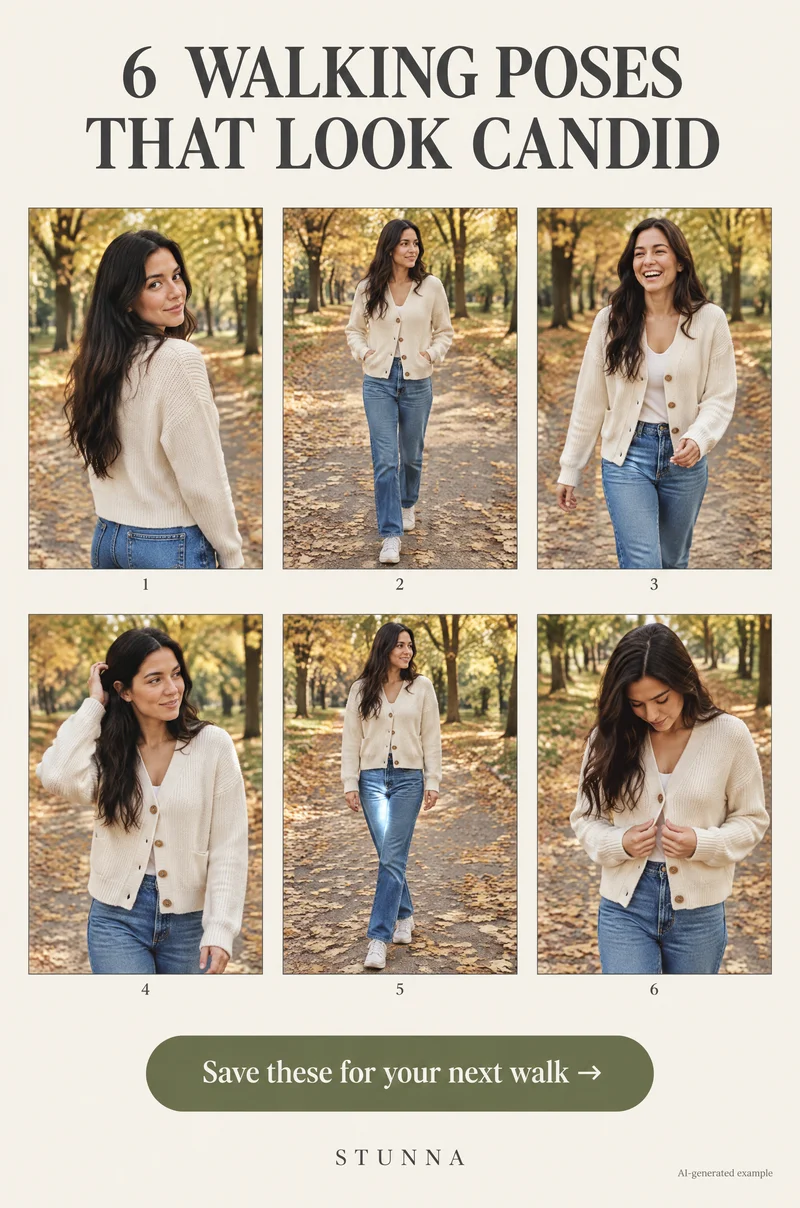
Walk a few steps toward or past the camera at a normal pace, and ask for several quick frames rather than one. Long coats look best on the step where the hem swings away from your legs. For more on this, see the walking photo poses guide.
Stiff vs relaxed: the easiest fix
If a photo looks stiff and you cannot tell why, check the arms first. Arms straight down by your sides almost always reads as tense. Three small changes relax it straight away.
- Hands in pockets: give your hands a job so they stop hanging.
- Weight on one leg: shift your weight to your back leg and soften the front knee. The coat hangs at a slight angle instead of straight down.
- A slight turn: angle your body a little away from the camera and bring your face back toward it. It slims the coat's outline and adds depth.
Framing long and short coats
Long coats need the full length in the frame. Ask the photographer to step back rather than zoom with the ultra-wide, and hold the phone around chest or waist height so your legs are not shortened. Leave a little space under your feet so the hem is not cut off.
Short coats and puffer jackets work well from mid-thigh up. Crop at the thigh, not the knee or ankle, since cuts at joints look accidental. A slightly lower camera angle makes a short jacket look less boxy.
Keep the background calm: a brick wall, a quiet street or a bare tree line lets the coat color stand out. If there is snow, the snow day photo guide covers exposure so the white does not turn grey. For festive evenings out, our guide to Christmas market photos covers the low-light side.
Common mistakes
These are the most frequent reasons winter coat photos fall flat.
- Arms pinned straight down: use a pocket, collar, drink or scarf.
- Standing still for every frame: walk or turn, then shoot.
- Shooting long coats with the ultra-wide up close: it distorts proportions; step back with the main camera.
- Hunched, cold shoulders: drop your shoulders and breathe out just before the frame.
- Cutting off the hem or feet: leave room at the bottom for full-length shots.
Phone tips for cold days
Use a short burst during movement poses so you can pick the frame where the coat swings and your face is relaxed. On overcast winter days, if faces look dim, tap the face and adjust exposure; [Apple's camera tools guide](https://support.apple.com/guide/iphone/use-camera-tools-iph3dc593597/ios) shows how on iPhone, and most Android camera apps have a similar slider after tapping to focus. More pose ideas are in the easy photo poses guide. For poses beyond coats, browse these 23 poses for pictures.
A few useful answers
What are good winter coat poses for photos?+
Hands in pockets, collar up, looking back mid-step, holding a warm drink, adjusting your scarf and leaning on a railing. Each gives your hands something to do.
How do I stop looking stiff in coat photos?+
Put your hands in your pockets, shift your weight to one leg and turn slightly away from the camera. Or walk and take the shot mid-movement.
How should I frame a long coat in a photo?+
Step back to fit the whole coat with the main camera, hold the phone around chest or waist height and leave a little space below the hem and feet.