THE BEST FRIEND POSE GUIDE
Best Friend Photo Poses: 6 Natural Ideas and 5 Tips
Six best friend photo poses for any two friends who feel awkward on camera: walk and talk, back to back, the secret, arm in arm, on the steps and the real mid-laugh. Plus five tips, where to stand, what to do with your hands, the walk-and-talk burst and timer tips.
Try the idea on your own photo with Stunna.


Free to download. Pro options available.
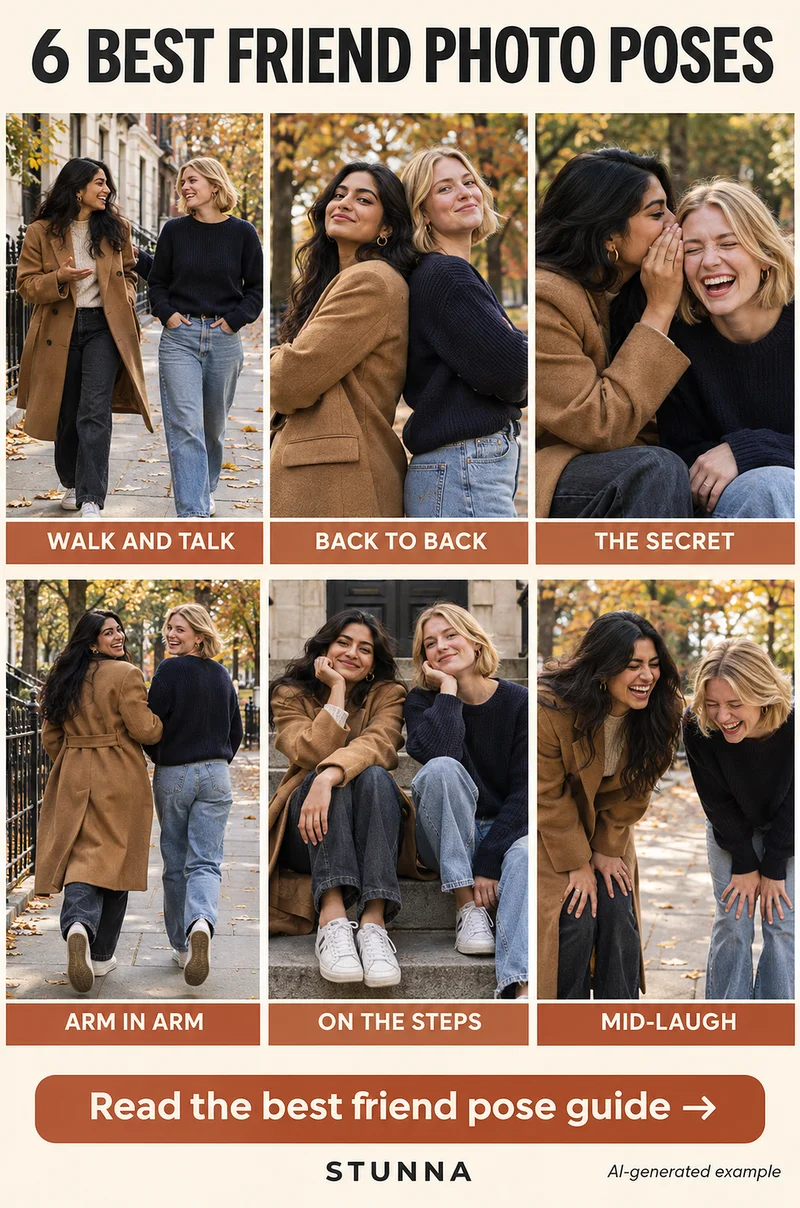
Most best friend photos go stiff the moment someone says smile. Two people stand side by side, arms hanging, both staring at the lens, and the result looks like a passport photo for two. The photos people actually keep look like the friendship: leaning in, laughing at something off camera, caught mid-sentence. This guide gives you six poses that create those moments on purpose, five tips that make any pose feel closer, the walk-and-talk burst that needs no posing at all and simple timer tips for when there is nobody to take the picture. The poses work for any two adult friends: two women, two men or a mixed pair. The illustrations are AI-generated examples, not actual Stunna results.
Why best friend photos look stiff
Posed photos of two people usually look stiff for three reasons: nobody is touching, both people are looking at the lens and nothing is happening. Real closeness shows in small things. Shoulders lean in, a hand rests on an arm, eyes go to each other. When those are missing, two close friends can look like strangers who happened to stand next to each other.
The fix is to give the two of you something to do rather than somewhere to stand. Walk, whisper, sit, laugh. The photographer's job is to catch the moment just after the action starts, when you have forgotten about the camera. That is why every pose below starts with an action, and why shooting a burst matters so much.
The 6 best friend photo poses
Try them in this order. The first two warm you up, the middle two bring you closer and the last two are the frames people tend to keep.
- Walk and talk: walk slowly side by side toward the camera, talking about anything, and ignore the lens. The photographer stays a few steps ahead and shoots a burst. The step-by-step version is below.
- Back to back: stand back to back with shoulders touching, arms crossed or hands in pockets, and both turn your heads slightly toward the camera. It works for friends of different heights, and a small smile or a shared laugh keeps it from looking like a standoff.
- The secret: one friend leans in and whispers something in the other's ear, ideally something genuinely funny, while the other reacts. Shoot from the side of the friend who is listening, so their face and reaction are clear.
- Arm in arm: link arms and walk a few steps away from the camera, then both glance back over your shoulders at the same time. Count to three out loud so the glance lines up.
- On the steps: sit on a step or a low wall, one friend a step higher than the other, leaning in shoulder to shoulder or with an arm around the lower one. Elbows on knees or hands around a coffee give your hands a job.
- Mid-laugh: stand close, look at each other and have one friend tell the worst joke they know, or both fake-laugh until it turns real. Shoot a burst through the whole thing; the real laugh usually arrives a second or two after the fake one.
Best friend photo tips: the 5 that matter
These five work with any of the poses above, and they are the quickest way to make two people look close in a photo.
- 01 Touch: arm, shoulder or hand. Always touch somewhere: a hand on an arm, a head or hand on a shoulder, linked fingers or shoulders pressed together. A small gap between two people reads as distance in a photo.
- 02 Look at each other, not the lens. Faces turned toward each other show the friendship. Save one or two frames of both of you looking at the camera for the classic shot.
- 03 Talk, then shoot a burst. Real conversation moves your faces naturally. The photographer shoots a burst while you talk, and you pick the best frame later.
- 04 Mix heights: one sits, one stands. Two heads at different heights make a more interesting shape than two heads in a row. One friend sits on a wall or step while the other stands or leans beside them.
- 05 Repeat one pose every year. Pick a favorite pose and place and take the same photo every year. Side by side, the set tells the story of the friendship better than any single shot.
The walk-and-talk burst, step by step
This is the easiest best friend photo because it needs no posing. Choose a quiet path or street with a simple background and soft light on your faces, such as late afternoon sun from the side or an overcast day. Start walking slowly toward the photographer side by side, about a shoulder's width apart or arm in arm. Talk about anything, from weekend plans to the worst date either of you has had, and ignore the lens.
The photographer stands a few steps ahead, holds the phone at about chest height and either walks backward slowly or stays still while you walk toward them, shooting a burst every few steps. On recent iPhones you slide the shutter button to the left for a burst; on many Android phones you hold or drag the shutter button, depending on the camera settings. Video is a fine backup: film a few seconds and pull a still out later, though a still from video is usually softer than a photo.
Afterwards, scroll through and pick the frame where you are both mid-laugh or mid-word, both faces are sharp, your feet are mid-step and nobody is blinking. Walking slower than normal helps more than you would think, and so does a gentle swing of the outside arms. Our walking photo poses guide covers where the photographer should stand and how to keep the stride natural.
Where to stand and what to do with your hands
Where the photographer stands: for two people, a few steps away at about chest height, level with you or slightly above. Shooting from low down makes you both look taller but can fill the frame with sky and chins. Leave a little space around you both so nobody's elbow or foot is cut off at the edge.
Where you two stand: closer than feels normal. A gap that feels friendly in person looks wide in a photo. Turn your bodies slightly toward each other, a quarter turn instead of square to the lens, so your shoulders overlap a little. If one friend is much taller, the taller one can lean, widen their stance or sit, which brings the faces closer together.
Hands: give every hand a job. One hand on the other's arm or shoulder, the other in a pocket, around a coffee cup, holding a bag strap or tucked into a linked arm. Avoid both arms hanging straight down, and avoid gripping each other tightly around the waist, which tends to look stiff. Our guide on what to do with your hands in photos has more ideas.
No photographer? Timer tips for two
When there is nobody to hold the phone, use the self-timer. Prop the phone at about chest height on a wall, a bench or a stack of bags, or use a small tripod. Set the timer to ten seconds so there is time to get into place, and frame the shot a little wider than you think so you both still fit after moving.
Some phones take a short burst on the timer, which helps with blinks; check your camera settings. If yours does not, take three or four timer shots in a row and change something small each time: a laugh, a glance at each other, a new arm position. A paired smartwatch or a small Bluetooth remote can trigger the shutter too, if you have one. The walk and talk works on a timer as well: start walking from a few steps back when the countdown starts and do several takes.
Adding more people later? The group photo guide covers spacing and blink checks for bigger groups, and if the person next to you is a partner, our couple photo poses use the same ideas of touch and action.
Common best friend photo mistakes
Pick a frame where both faces look like you at your best together, rather than the one where only one of you looks great. A best friend photo belongs to both of you.
- A gap between you: stand closer than feels natural and touch somewhere.
- Both staring at the lens in every frame: look at each other for most shots and save the camera look for one or two.
- One photo per pose: always shoot a burst or several frames; the best moment is rarely the first.
- A busy background: crowds, bins or bright signs pull attention away from you. Move a few steps or turn so a plain wall, trees or a quiet street runs behind you.
- Copying a reference exactly: matching every limb to a Pin looks stiff. Use the pose as a starting point and let it move.
- Harsh midday sun in your eyes: squinting faces rarely make the cut. Find open shade or turn so the sun is beside or behind you.
A few useful answers
What are good poses for best friend photos?+
Start with an action: walk and talk, back to back, whispering a secret, arm in arm glancing back, sitting on steps and laughing at each other. Touch somewhere and look at each other more than at the lens.
How do we make best friend photos look natural?+
Give yourselves something to do, talk while the photographer shoots a burst, stand closer than feels normal and pick the frame where you are both mid-laugh.
Do these poses work for two guy friends or a mixed pair?+
Yes. Walk and talk, back to back, on the steps and mid-laugh work for any two friends. Swap a head on the shoulder for a hand on the shoulder if that feels more like you.
How do we take best friend photos without a photographer?+
Prop the phone at chest height, set a ten-second timer, frame wider than you think and take several shots, changing something small each time.
What is a good yearly best friend photo idea?+
Pick one pose and one place, such as the same steps or the same street, and repeat it every year. Lined up together, the photos tell your story.