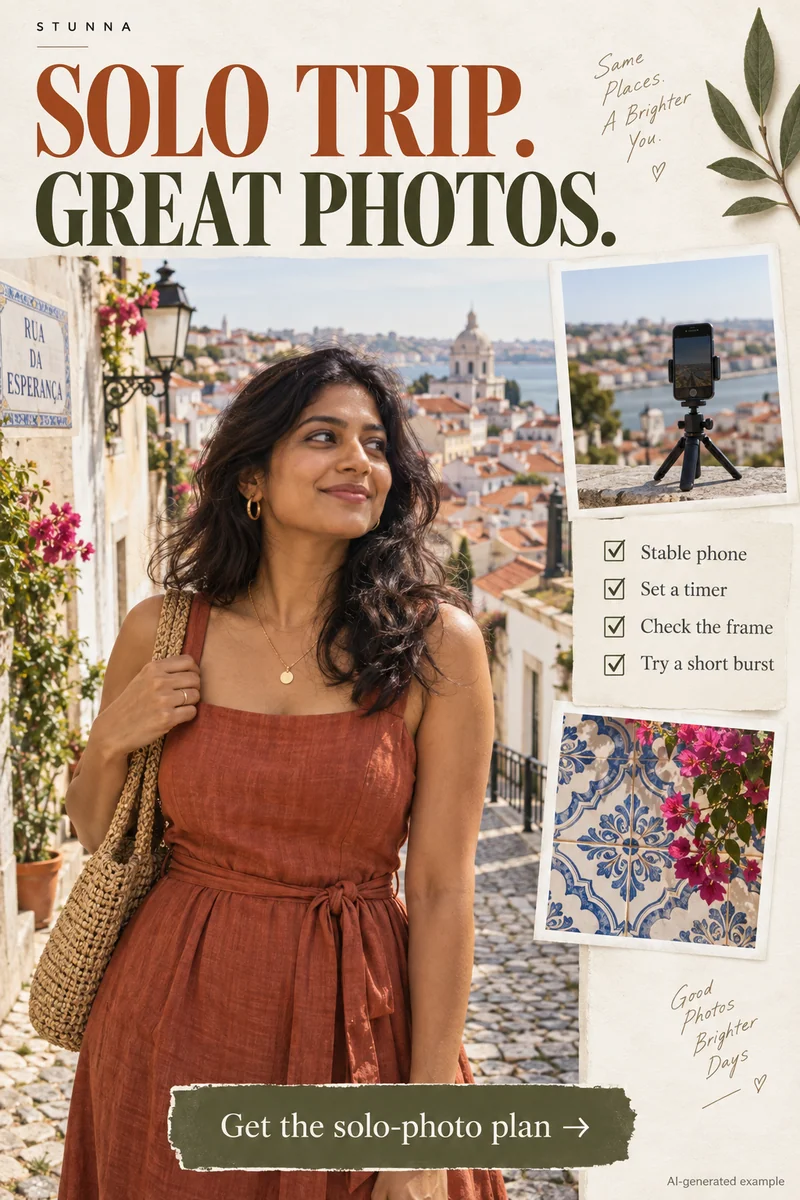
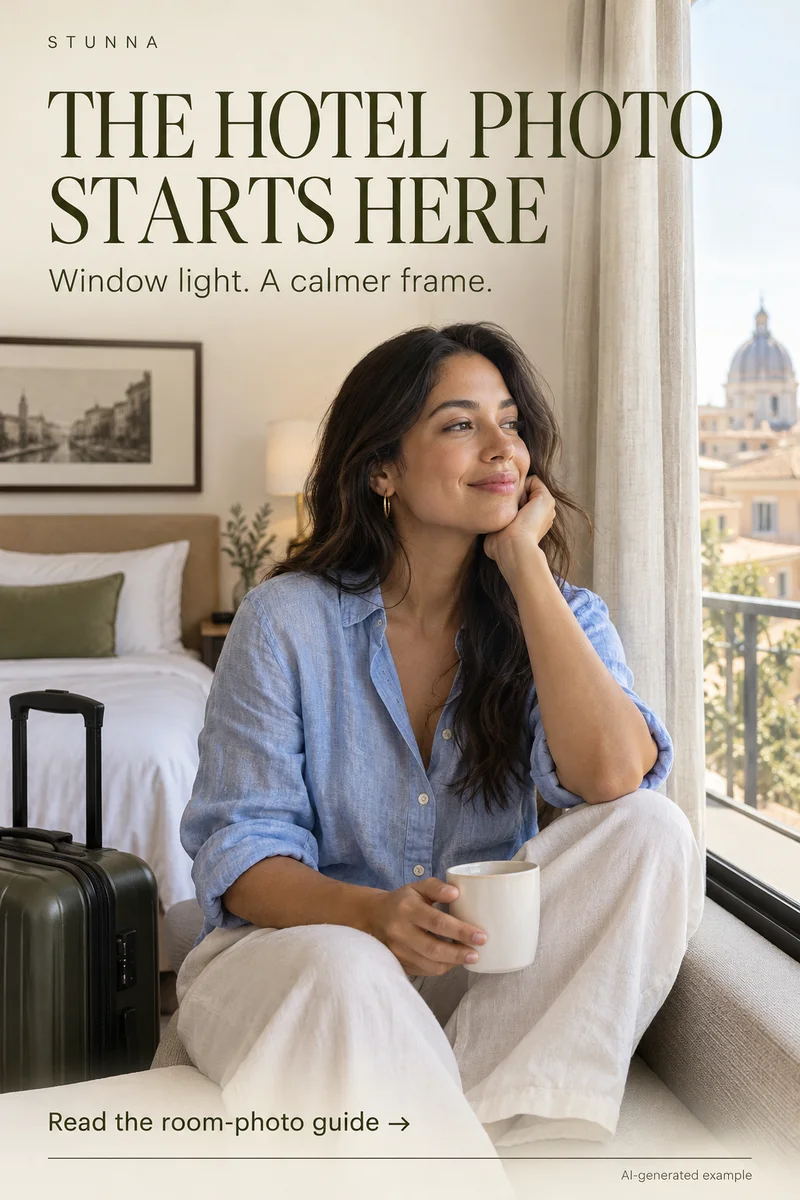
THE CROWD-FREE TRAVEL PHOTO GUIDE
How to Take Travel Photos Without Tourists: 5 Tricks
Go before 8 am, shoot from a low angle so heads drop out of frame, step close and crop tight, use the quieter side street and shoot a burst while you wait for gaps. Plus careful cleanup edits and how to be a considerate visitor.
Try the idea on your own photo with Stunna.


Free to download. Pro options available.
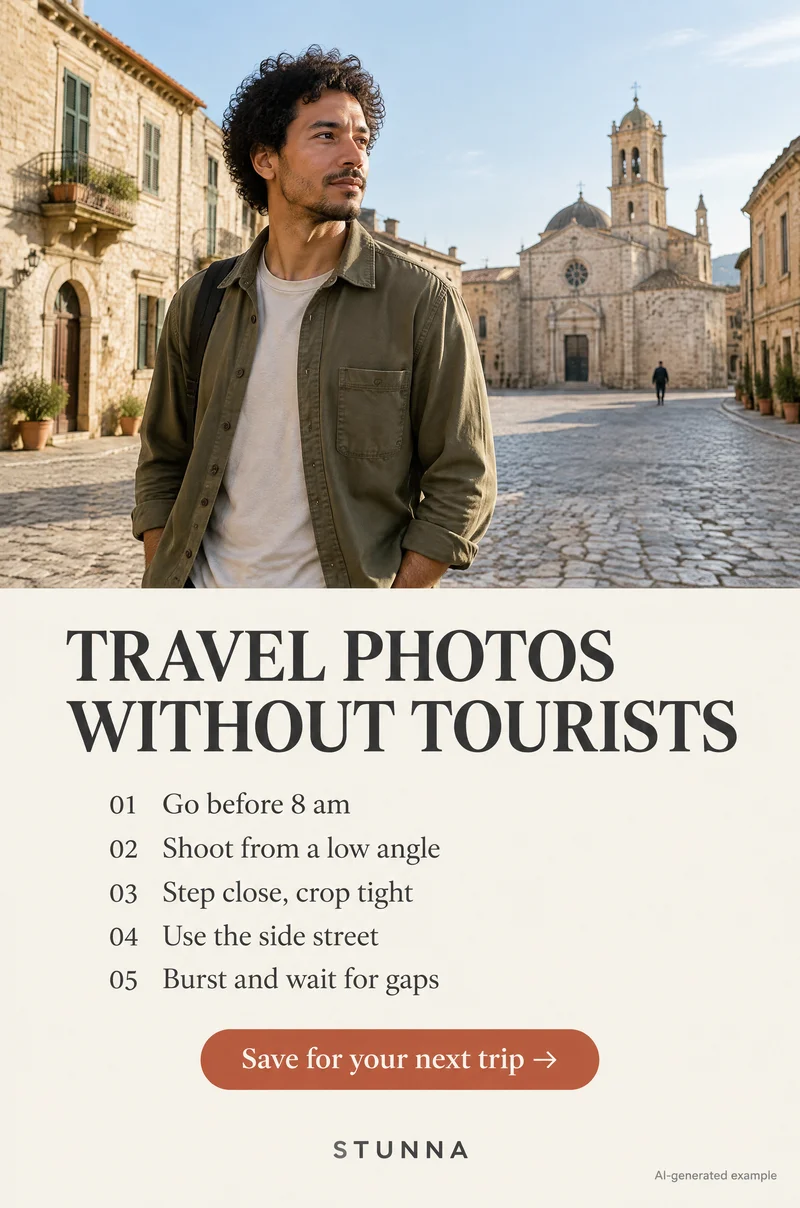
Famous places are famous for a reason, so you are rarely alone at them. You can still come home with clean travel photos. Timing does most of the work, and a few framing choices take care of the rest: shooting low, cropping tight, moving one street over and waiting for gaps. A careful cleanup edit can then handle the one or two strangers left. These are tips for your own photos; the illustrations are AI-generated examples, not actual Stunna results.
Why your travel photos fill up with strangers
Most visitors arrive at landmarks in the same window: after breakfast, when tour buses and guided groups arrive, through to the late afternoon. Midday is often the busiest time and also the harshest light, with hard shadows under the eyes and a washed-out sky. The same bridge or square can look like a different place at 7:30 in the morning.
Crowds are also a framing problem. A wide shot from standing height includes everyone between you and the landmark. Change the time, the height of the camera or how much of the scene you include, and most of those people leave the picture without anyone having to move.
Travel photos without tourists: the 5 tricks
Save these for your next trip. Use one or combine several, depending on how busy the place is.
- 01 Go before 8 am: arrive early, when the streets are quiet and the light is soft. Many landmarks are almost empty in the first hour after sunrise.
- 02 Shoot from a low angle: crouch and hold the phone near knee height, tilted up slightly, so heads in the background drop below the frame and the sky and buildings fill the space.
- 03 Step close, crop tight: frame the person from mid-thigh or waist up against one strong detail, like a doorway, column or wall, rather than the whole square.
- 04 Use the side street: walk one street over from the famous spot. A colored wall, a door and a plant make a cleaner portrait than a packed landmark.
- 05 Burst and wait for gaps: crowds move in waves. Keep the frame set up, wait for a gap and shoot a burst, then pick the frame where the background is clearest.
Go before 8 am
Early morning is the single biggest change you can make. Check sunrise time the night before and aim to arrive around it or within the first hour. In summer that might mean 6 am; in winter, sunrise can be late enough that 8 am is still early light. Many outdoor squares, bridges and viewpoints are open at any hour, but check opening times for gardens, churches and paid sites.
The light helps too. Low morning sun is softer and warmer than midday, so faces look better and you squint less. Pick your outfit and route the night before, and plan to shoot the busiest landmark first, then the quieter spots as the city wakes up. The same spot at noon and at 7:30 am can look like two different places: one full of people walking through the frame, the other calm with only a few early walkers.
If early starts are not possible, late evening is the next best option at many places, once day-trippers leave. Our city break photo guide has a full shot list to fit around short days.
Shoot from a low angle
Lowering the camera hides people behind your subject. Crouch so the phone is around knee or hip height, and tilt it up slightly. People in the middle distance drop below the bottom of the frame or are hidden by the person you are photographing, and the background becomes upper floors, rooftops, towers and sky.
Keep the subject fairly close so they still fill the frame, and use the main lens rather than the ultra-wide. The ultra-wide exaggerates the low angle, stretches legs at the edge and leans buildings inward. A small tilt is enough; if buildings start to look like they are falling backward, raise the phone a little. Low angles work especially well for full-length outfit photos, because legs look longer when the camera sits below the waist.
Step close and crop tight
You do not need the whole landmark to say where you were. A carved doorway, a column, a patch of tiles or one corner of a fountain often tells the story better and leaves far less space for strangers. Frame from mid-thigh or the waist up, and fill the background with one detail of the place.
Use the 2x lens or step closer rather than zooming in heavily, which can soften the photo. Position the person so their body blocks the busiest part of the background. A slight change of angle, a step left or right, can line a stranger up behind your subject so they disappear. Our clean background photo guide explains how to change the frame before you think about removing anything.
Use the side street
When the famous square is packed, walk one street over. Side streets in old towns often have colored walls, painted doors, plants in pots and soft shade, without the crowd. Stand a step or two away from the wall, frame from mid-thigh up and let the wall fill the background. A door and a plant give the frame shape without needing a landmark.
Late afternoon light in narrow streets is often soft and bounced, because sunlight hits one wall and reflects onto the other side. Watch for a strip of open shade where the face is evenly lit. Remember these are often residential streets: do not sit on someone's doorstep, block a door or photograph people's homes through windows. Our solo travel photo guide has a setup for getting yourself in the frame with a timer if you are traveling alone.
Burst and wait for gaps
Crowds move in waves. A group passes, there is a gap of a few seconds, then the next group comes. Set up the frame, have the person hold their pose and watch the background rather than the subject. When a gap opens, hold the shutter or use burst mode and take a short run of frames.
Later, pick the frame where the background is clearest and the person looks natural. Two minutes of patience often gives you a frame with no strangers or only one far away. If someone stops in your shot, wait for them to move on rather than asking them to leave; they are visiting too.
Clean up the rest carefully
Timing and framing remove most people. For the one or two left, crop first: a slightly tighter crop often removes a stranger at the edge without any editing. Then use a removal tool for small, distant figures only. Large people close to your subject, or someone overlapping your friend's outline, are much harder to remove cleanly.
After any removal, zoom in and check the repair. Look for repeated cobblestones or windows, bent railings, smudged edges around hair and hands, leftover shadows or reflections of the removed person and signs or text that have turned into nonsense. If the fix is visible, undo it and try a smaller crop instead. Our ChatGPT photo background prompts show how to describe a removal clearly if you use a chat editor.
Be respectful of locals and other visitors
Getting a clean shot should never come at someone else's expense. Popular spots are also people's homes, workplaces and places of worship.
- Do not block paths, entrances, stairs or bike lanes while you set up. Step aside between takes.
- Respect signs that ban photography, tripods or drones, especially in churches, museums and private courtyards.
- Avoid making strangers the subject of your photos, and ask before photographing people up close.
- Keep early-morning shoots quiet in residential streets; people are still asleep.
- Do not climb on monuments, walls or fences, or step into flower beds for an angle.
- If a spot has a queue for photos, take your turn quickly and let the next person go.
A few useful answers
What time is best for travel photos without crowds?+
Early morning, ideally before 8 am or within the first hour after sunrise. Landmarks are quieter and the light is softer. Late evening can also be calmer once day-trippers leave.
How do I hide tourists in the background?+
Shoot from a low angle so heads drop out of frame, step close and crop tight against one detail, and position your subject so they block the busiest part of the background.
Is it okay to remove people from travel photos?+
For your own photos, removing a distant stranger is common. Keep edits small, check the repair at full size and avoid changing the place itself in a way that would mislead people.
Why do my edits leave smudges where people were?+
Removal tools rebuild the background, which is hard with repeating patterns, railings or people close to your subject. Crop tighter first and only remove small, distant figures.
How do I get photos at a busy landmark without blocking others?+
Set up quickly, step aside between takes and wait for gaps rather than asking people to move. Respect signs about photography and keep paths and entrances clear.