THE CITY BREAK PHOTO GUIDE
City Break Photo Ideas: A 12-Shot Travel List
Start with six easy city shots, build them into a 12-shot plan, beat the crowds at landmarks and edit the set so it feels consistent.
Try the idea on your own photo with Stunna.


Free to download. Pro options available.

A long weekend in a city produces hundreds of photos and, somehow, no good photo dump. The problem is usually variety: too many similar wide shots and not enough details, people or light. This guide starts with six easy shots, turns them into a 12-shot plan for autumn and winter trips, and covers crowds and editing. The images on this page are AI-generated examples, not actual Stunna results.
The 12-shot city break list
The first six are the core list: quick to get anywhere. The next six add people, night and texture. You do not need all twelve on day one; tick them off across the trip. Our travel photo dump guide explains how to order them once you are home.
- The street sign: a local street name, metro sign or shop front that says where you are without a caption.
- Coffee from above: your cup on a café table, shot straight down, with a sleeve, map or pastry at the edge.
- You, small in the view: stand far back so the city is the subject and you are a small figure for scale.
- A window at dusk: a lit café, bookshop or apartment window as the sky turns blue.
- Ticket or map detail: a museum ticket, train pass or paper map in your hand.
- One wide skyline: a single view from a bridge, hill or rooftop that shows the whole place.
- Walking away: you or a friend walking down a quiet street, shot from behind.
- A market or food stall: hands, steam, signs and color, focused on the food rather than strangers’ faces.
- Texture close-up: cobbles with fallen leaves, a tiled doorway, a frosted railing or a door knocker.
- Reflection: a puddle, shop window or river that doubles the lights.
- Night lights: a lit street, festive lights or a glowing tram stop after dark.
- The quiet end: your hotel window view, packed bag or the last coffee before the train.
Shoot the list in short autumn and winter days
Daylight is short on a cold-season break, so plan around it. Mornings are for landmarks and markets, midday for interiors and food, and the early dusk is a gift: windows, street lights and reflections all appear before dinner. Gloves with touchscreen tips and a charged power bank help more than any setting.
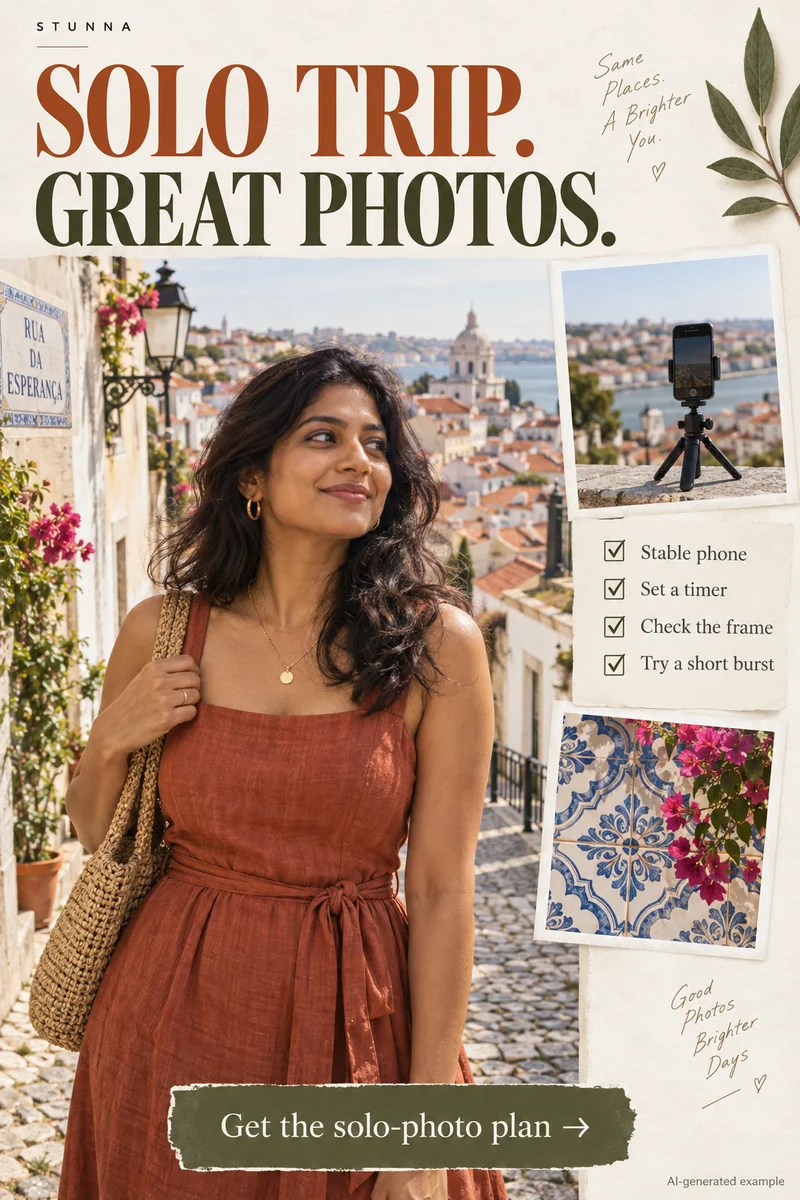
For shots of yourself, a self-timer and a steady ledge go a long way; our solo travel photo guide covers that. If you have a friend with you, our walking photo poses make shot seven easy. On a New Year break, the sparkler photo guide covers safe sparkler shots, but follow local rules, since some cities restrict them in public places.
Beat the crowds at landmarks: go early, frame tight, shoot a few
Go early. The first hour after sunrise, or just after opening time, is usually the quietest at famous places. Frame tight: crop to a detail, a doorway or one column instead of the full façade, and the crowd disappears outside the frame. Shoot from low to put people below the bottom edge, or look up so the sky becomes the background. Then shoot a few frames in a row, because people move and one frame often has a gap.
Be considerate while you do it. Do not block paths or entrances, respect signs where photography is not allowed, including in many churches, museums and galleries, and avoid making strangers the focus of your pictures. If a tourist steps into the frame, wait rather than asking them to move.
Night shots, markets and festive lights
Autumn and winter city breaks come with early darkness, Christmas markets and lit-up streets, which fill shots ten and eleven fast. Brace the phone against a lamp post or railing, let night mode do its work, and keep people still for a second while you shoot. A wet pavement after rain doubles every light, so look down as well as up.
At busy markets, photograph stalls, steam and decorations rather than strangers’ faces, and ask before photographing a stallholder up close. Warm bulbs can turn skin orange; shoot a test frame and step toward whiter light if faces look off. Our string light photo guide has more ideas for festive lights.
When Crowd Eraser is worth trying
Removing people works best when they are small, at the edges and not overlapping you. Stunna’s Crowd Eraser is designed for that kind of background clean-up. It is worth a try when a near-perfect landmark photo has a few figures in the distance, and less likely to look right when a crowd fills the frame or someone is touching your shoulder. Expect repaired areas to need a careful look.
Check that signs, windows and architectural lines still make sense afterwards. If you prefer writing your own prompts, our ChatGPT photo rescue prompts include a busy-background prompt. If the photo includes blinking friends, see the blink photo guide first.
Edits that keep the set consistent
A photo dump looks planned when the edits match. Pick one look and use it on every frame: a dark, contrasty city grade, a warm film feel or a clean, natural edit. Apply it, then nudge exposure per photo rather than changing the whole style. If one color dominates a night shot, such as a red neon sign, our red light photo guide has tips for keeping skin believable.
Borders can tie the set together: add the same frame to every image with the white border tool, or give a few favorites an instant-print feel with our polaroid photo guide. For the opener, our photo dump cover guide helps you choose the strongest first slide. When you post, mix the order so two similar wide shots never sit next to each other, and end on something quiet.
A few useful answers
How many photos should a city break photo dump have?+
Most carousels feel complete at around ten to twelve. A mix of details, people, wide views and night light matters more than the exact number.
How do I photograph a landmark without crowds?+
Arrive early, frame a tight detail, shoot from low or looking up, and take several frames to catch a gap. Removal edits are a last resort.
Can I take photos anywhere on a city break?+
No. Follow signs and staff instructions where photography is restricted, and be considerate of people who do not want to be photographed.